Prediction market hedge calculator: cover your cost or lock the result
Enter what you hold, what you paid and the price of the opposite side. The calculator shows what you net if the leg hits and if it misses, for any hedge size.
Your position
Use this for any single contract, or for a combo once only one leg is left open.
Outcomes
| If the leg… | Position | Hedge | Net |
|---|---|---|---|
| Hits | +$82.00 | −$10.62 | +$71.38 |
| Misses | −$18.00 | +$18.38 | +$0.38 |
Cost covered: a miss nets +$0.38, and a hit still nets $71.38.
full lock: hedge contracts = contracts held → net = N × (100 − paid − opposite)
Worked example
You hold 100 contracts bought at 18¢, so $18.00 is at risk. Every other leg has settled, and the opposite side of the last leg trades at 35¢.
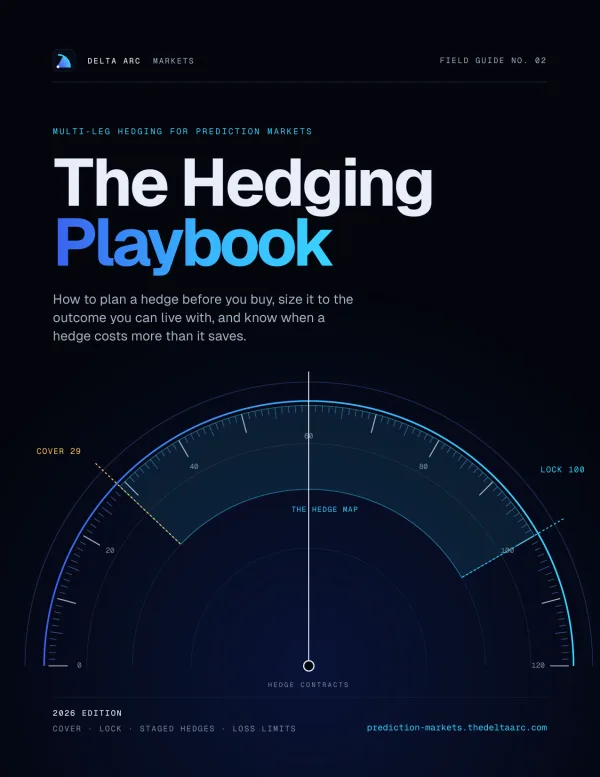
- Cover your cost: 29 opposite contracts cost $10.15 plus a 47¢ fee. If the leg misses, they pay $29.00 and you finish +$0.38. If it hits, you still net $71.38, keeping 87% of the unhedged upside.
- Lock the same result: 100 opposite contracts cost $35.00 plus a $1.60 fee. Either way you net about $45.40.
- No hedge: a hit pays $82.00 and a miss loses $18.00.
Why a full lock is simple
Exactly one side of a contract pays $1. Holding equal numbers of both sides guarantees $1 per pair, so the lock size always equals what you hold.
When a lock loses money
If what you paid plus the opposite price is exactly 100¢, a full hedge breaks even before fees. Above 100¢ there is nothing left to lock, and hedging only limits the size of the loss.
Hedging a combo
A combo can only be hedged leg by leg. Once one leg is left, buying its opposite side works the same as hedging a single contract.
Free guide: The Combo Tax
A short PDF on reading combo quotes, spotting markup and sizing a hedge, with worked examples. Delivered by email.
Questions
How many contracts do I need to lock the result?
Buy as many opposite-side contracts as you hold. One side always pays $1, so you net 100¢ minus what you paid minus what the hedge cost, per contract, before fees. It only works when the two prices add up to less than 100¢.
How do I hedge just enough to cover my cost?
Divide what you paid in total by what each opposite contract pays if it hits (100¢ minus its price), then round up. With 100 contracts bought at 18¢ and the opposite side at 35¢, that is 28 contracts before fees and 29 with fees.
Can I hedge a combo?
Once every other leg has settled, a combo pays only on the last open leg, so it behaves like a single contract. Buying the opposite side of that leg hedges it.
Related calculators
Go deeper
The numbers you just ran, explained start to finish
The playbook, the journal and all four 2027 event guides, $96 bought separately.