Everything bundle
The playbook, the journal and all four 2027 event guides.
Type in your legs and the quote. In ten seconds you see what you're really paying for the bundle.
Free · No signup · Works for sports, CPI, the Fed, elections, anything that settles yes or no
$13 of every $100 you put on this combo is markup.
Legs treated as unrelated. The full calculator handles related legs and fees.
Source: Sportico analysis of public Dune data, 2026.
The guides
The playbook, the journal and all four 2027 event guides.
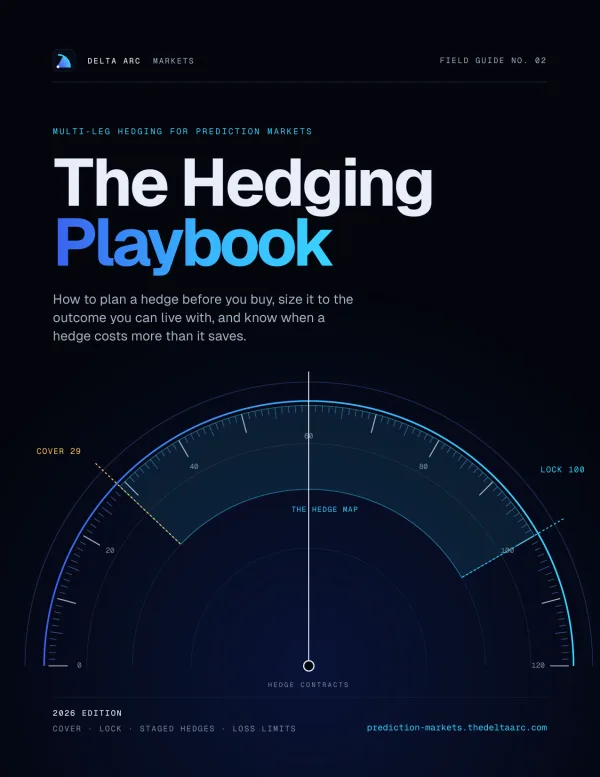
Cover your cost, lock the result, or cap the loss, sized before you buy.
See where you actually make and lose money. Excel and Google Sheets.
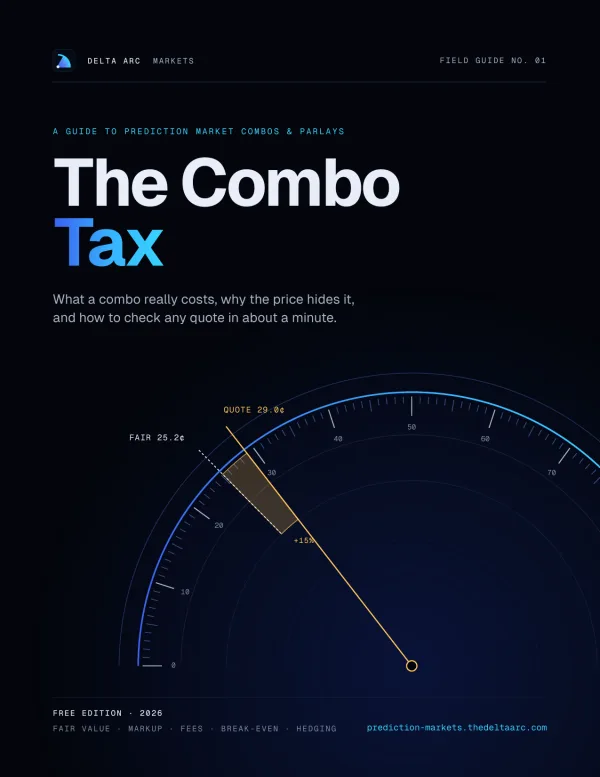
The 10-page guide to what a combo really costs.
Event guides, $12 each
Free tools
Markup, break-even and expected value.
Check a combo →Both outcomes for any hedge size.
Plan a hedge →Cents to odds and back.
Convert a price →The fee, your all-in cost and break-even.
Price an order →Is the price worth it at your odds?
Run the EV →Add up a field and strip the markup.
Read a field →New to this? How prediction markets work, in one page → · Glossary →
Every one pays $1 if it settles yes. What you can trade, and how to read any contract →
A prediction market lists contracts on real outcomes, such as a game, a CPI release, a Fed decision, an election or the weather. Each contract pays $1 if it settles yes and $0 if it doesn't, so its price in cents reads roughly as the market's probability.
A price of 62¢ means the market puts the outcome near 62%. You pay the price plus a fee, so your break-even is a little above it. The yes and no sides add up to about 100¢.
A combo, called a parlay at a sportsbook, is one contract that pays $1 only if every leg settles yes. Its fair reference price is the legs multiplied together. The quote is usually higher, and the difference is the markup.
Multiply the leg prices as probabilities and compare the result with the quote. Three legs at 62¢, 58¢ and 70¢ multiply to about 25.2¢, so a 29¢ quote carries about a 15% markup. The meter above does this as you type.
Yes. Buying the opposite side of a contract limits what you can lose. Hold the same number of contracts on both sides and you get the same result whichever way it settles, as long as the two prices add up to less than 100¢.
No. These tools and guides explain how prices, fees and hedges work. They don't predict outcomes or recommend trades, and event contracts can lose 100% of what you pay.